A gift card 20% off is usually a problemHow to buy gift cards and top-up codes, where to buy safely, and where the discount comes from

You buy a card, scratch off the code, type it in. That is the whole appeal: nothing gets linked to anything, so money reaches an overseas account without you owning a foreign card at all. Two conditions are non-negotiable, and getting either wrong wastes the money: the region and denomination have to match your account, and the seller has to be the platform itself or an authorized retailer. As for the codes online selling 20% below the official price, almost none of them are a good deal. Most readers land here after an app store, Steam or a streaming service has bounced their own card one time too many. If what you actually want is to understand virtual cards, the explainer covers that ground instead.
What's in this guide (open the outline)
- What a gift card actually saves you
- Region, currency, denomination: three things you can get wrong
- Where buying counts as legit: official, authorized retail, and cheap resellers
- A card "20% off": where the discount comes from, and the trap
- Card number, PIN or claim code: which one gets typed in?
- From buying the card to redeeming it, end to end
- When to put your wallet away
- A few questions people ask
What a gift card actually saves you
Picture a situation you've probably been in. You want to put 50 into an overseas app store account so you can buy a subscription, but your local card gets declined the moment it hits checkout; the issuer's cross-border risk control won't accept the transaction. A gift card is the way around that wall. Instead of "paying by card", you buy an official gift card with a face value of 50, type the string of characters printed behind it into your account, and the balance appears.
The key point is that no foreign card touches the process at all. Where you bought the card and how you paid for it have no direct link to the account that finally receives the balance. For anyone whose account lives overseas but whose payment method is stuck at home, that's a real shortcut: no opening a foreign-currency card, no clearing 3DS, no explaining to the issuer why you want to shop on a site in another country.
And because a gift card is fundamentally just "a string of characters that converts into balance", it carries its own weakness: once the code leaks or someone redeems it ahead of you, the money is gone, with no way to report it lost or claw it back. That single trait runs through every judgment that follows. You'll notice that anyone who wants you to "send the code over first" is almost always aiming at exactly this weakness.
Region, currency, denomination: three things you can get wrong
Not every gift card can be pushed into your account. Before you buy, confirm three things line up, or the card is genuine, the money is spent, and it still won't load, with no refund.
- Region must match the account. A US app-store card won't load into a Japan-region account. Steam runs one global wallet, but some cards still carry a currency lock. Check which region your account is registered in before you buy, then buy the matching card.
- Currency has to match. The same platform issues cards in different currencies across countries. A dollar card redeemed into an account priced in euros will either throw an error outright or convert under the platform's own rules, taking an exchange-rate cut you never see.
- The denomination has to be enough, and ideally round. Subscriptions often need the balance to be "just enough or slightly more" before the charge succeeds. Being short by a few cents fails a charge; buying lots of tiny denominations may leave you unable to make up the total. Check the amount due first, then pick the denomination.
Of these three, getting the region wrong is the most common and the hardest to fix. Currency and denomination can be topped up some other way, but a card for the wrong region can usually only be passed on or written off. So the checking order is always region first, then currency, then denomination.
On many platforms, the "region" printed on the packaging means where the card was issued, which isn't necessarily the region of your account. They sound alike but they're two different things. The safest move isn't to guess from the box. Go to your account's "top up / redeem" page, read which card and which region it explicitly supports, then go back and buy. When the packaging and the account don't agree, the account page wins.
Where buying counts as legit: official, authorized retail, and cheap resellers
The same "identical-looking" card carries wildly different risk depending on where you bought it. Sort channels into three tiers and you'll know where to head and what to avoid.
- The platform's own store. Buying balance or a top-up directly inside the app store, game platform or streaming service's own site or app is the safest tier. It never goes through a physical card, so there is far less risk of a code being exposed before you redeem it. When you can buy from the official source, do.
- Authorized retail channels. The physical gift cards on the shelves of large chain stores and reputable retailers' own listings are authorized issues. The card is sealed when you buy it, activation happens at the moment of checkout, and the receipt makes it traceable. This tier suits the case where "the account can't take a payment, so you can only buy a physical card to redeem".
- Third-party cheap resellers and loose codes. The "discount codes" and "top-up services" posted in forums, chat groups and obscure little sites are often tempting on price, but what you receive is just a string of characters someone sent you. You can't see where it came from, whether it has already been used, or whether it was activated with a stolen card. This is the accident-prone tier, and the next section takes it apart.
There's a simple yardstick for whether a channel is trustworthy: are you getting "a sealed physical card or official account balance", or "a string of characters someone sent you privately"? The former keeps risk under control; with the latter you have almost no protection.
A card "20% off": where the discount comes from, and the trap
Gift-card prices are relatively fixed, and platforms almost never discount their own cards heavily. So when someone can reliably sell you a card 20% below the official price, that gap has to come from somewhere, and there's almost no honest source for it. Each of the common "ways to be cheap" is really someone else's risk being passed to you:
- Activated with a stolen card. Buying gift cards in bulk with stolen cards costs the seller nothing, so they can undercut everyone. When the real cardholder notices and disputes the charge, the platform freezes the whole batch of gift cards, and the balance you loaded vanishes overnight.
- The code has already been used. The code you bought was redeemed once already by the original holder or the seller themselves, so what reaches you is an empty shell. You find out the balance is zero only when you go to load it, and by then the other party is long gone.
- Phishing for your codes. Some "low prices" aren't about selling a card at all. They're bait to send you to a spoofed page that asks you to enter your account, payment details, or even codes you already hold, in order to lift what you've already got.
Sent in a group / DM"Official cards, 15% off. Send me your redemption code or account first, I can activate it faster on my end, totally legit."
In the end, in the gift-card market a discount has to have a reason. Official and authorized retail can't offer deep cuts; whoever can is usually saving on "whether the money behind this card is clean". The 20% you save corresponds to the odds of your balance being wiped to zero.
Card number, PIN or claim code: which one gets typed in?
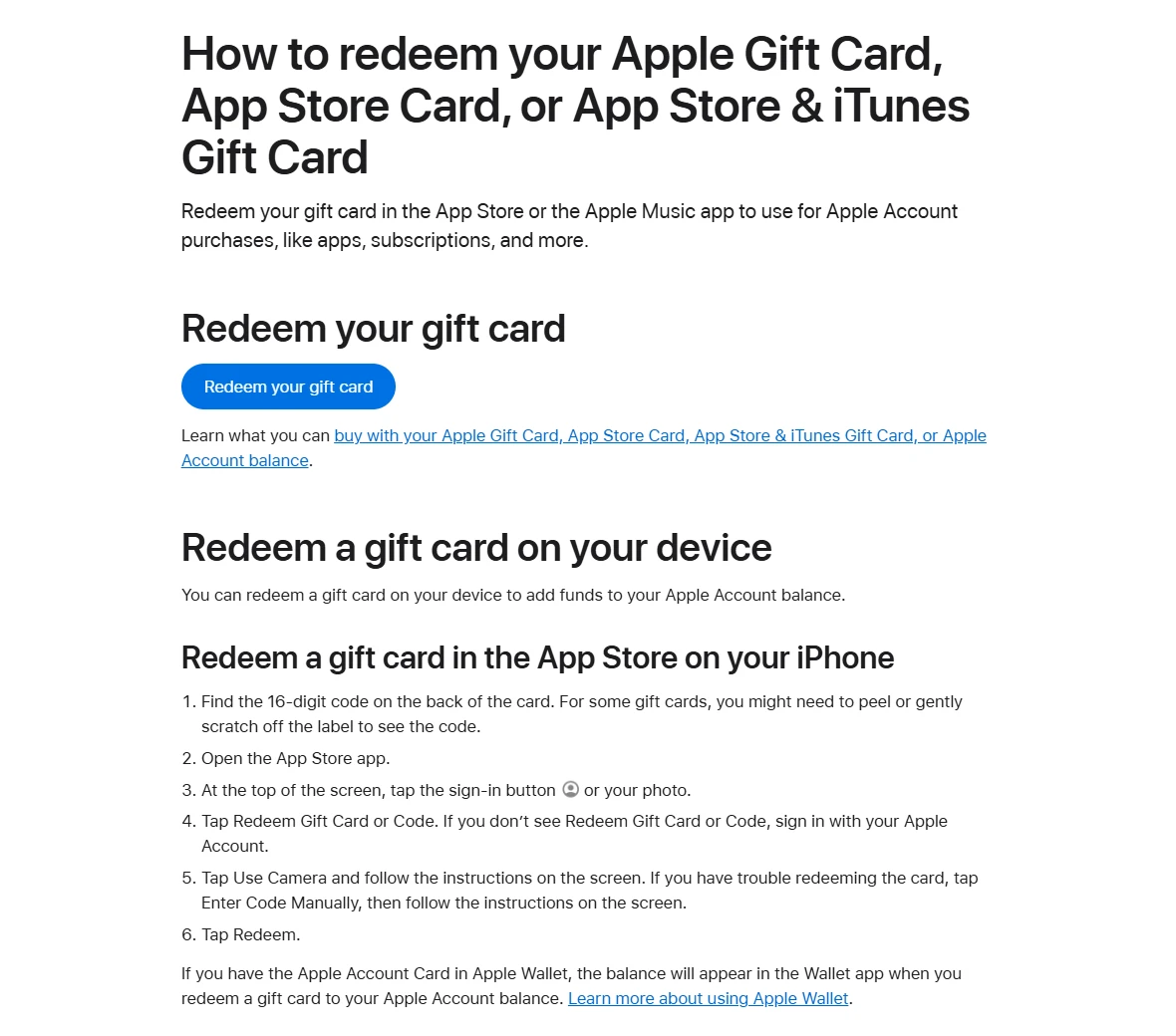
The one you redeem is almost always the string you can't see on the shelf: under a scratch-off strip or a peel-off label on the back, or in the body of the email when you bought a digital card. Apple's redeem page puts it plainly for its own cards: find the 16-digit code on the back, and on some cards peel or gently scratch off the label to see it. Everything else printed on the card has a different job.
- The long number printed in the open, often beside a barcode, is the card number. The till scans it to activate the card when you pay, and some brands ask for it when you check a balance. It isn't what you type into your account.
- A PIN, where there is one, sits under its own strip. Cards meant to be spent at a shop's own checkout often want the card number and the PIN together; cards redeemed into an app store or game account usually have no PIN at all.
- The claim code, also called a redemption code, is the one an app store, game platform or streaming service asks for. Treat it like cash: whoever types it in first owns the balance.
When a code won't go in, reread it before anything else. Letters and digits that look alike (O and 0, I and 1, S and 5, B and 8) cause most failed attempts, and the camera option on the redeem screen, where there is one, avoids the problem. If you scratched too hard and a character has gone, stop guessing and contact the issuer's support with the receipt and a photo of the card. Two other messages point somewhere specific. "Not active" or "not activated" usually means the till never activated the card, so the shop that sold it is where to go, receipt in hand. "Already redeemed" on a card you have only just bought is a matter for the issuer, and a good reason not to buy from that seller again.
From buying the card to redeeming it, end to end
Pull all of the above into a routine you can follow. Tick off this list before you buy, and only pay once everything checks out:
- Region right? The card's region matches the region your account is registered in, going by what the account's redeem page says, not by guessing from the packaging.
- Currency right? The card's denomination currency matches the account's pricing currency, so you don't lose an exchange-rate cut to conversion.
- Denomination enough? The face value covers the amount you owe, with a little margin for subscriptions; don't buy lots of tiny denominations.
- Channel legit? It's official platform balance, or a sealed physical card from authorized retail; not a loose code sent to you privately.
- Kept the receipt and code? Save the purchase receipt or order number and a screenshot of the code on the card or in the email; if redemption goes wrong, this is the only thing that lets you trace it.
Remember the working order in three lines: go to the account page and confirm which region, which currency and how much you're topping up; buy the matching card through an official or authorized channel, and save the receipt and order number the moment you pay; redeem the card as soon as you have it, don't stockpile it, and never send the code to anyone in advance. If you bought a physical card, scratch and load it on the spot; if you bought official balance it's even simpler, just enter it and confirm it landed. Run the whole routine and the code passes only once, between you and the official platform, leaving no opening for any middleman.
When to put your wallet away
The awkward part of gift cards: once the money is gone, a redemption code cannot be returned. So when any of these signals shows up, don't buy, however tempting the price:
One: you're asked to "pay first" or "send the code or account over first" before delivery. A legitimate purchase is money for a sealed card or official balance, hand to hand; there's no "send me your code first" step. Whenever the order is flipped, it's almost always aimed at making off with what's yours.
Two: it can only be done privately, over a transfer you can't reverse. The other party insists on closing the deal in a chat group or DM and won't use any channel with support and a record. If something goes wrong, you won't even know who to find.
Three: the price is far below market. Official and authorized retail can't offer deep cuts, so "20%, 30% off" is basically telling you the card's origin is suspect. Cheap beyond reason is the biggest red flag of all.
A few questions people ask
- I bought a gift card for the wrong region. Can it be fixed?
- In most cases, no. The region is locked to the card, a card from another region won't redeem into your account, and platforms generally won't accept a return or swap. The safest move is to check carefully against your account's redeem page before you buy, not to count on adjusting it afterward.
- Gift card or virtual card, which should I use?
- It depends on the situation. A gift card is "load a fixed amount into one specific account, once", which suits app stores, games and streaming services that take cards directly. A virtual card is "a card number you can charge repeatedly", which suits subscriptions that need a card on file and bill monthly. They solve different problems, so check each one's guide before you choose.
- If I'm careful, are cheap cards fine to use?
- The risk isn't about how careful you are; it's that you can't see where the card came from. A card activated with a stolen card is a real card with a real code, and the moment you load it everything looks normal, but once the original cardholder disputes it, the platform freezes the batch and your balance is wiped all the same. No amount of care stops that step.
- Someone glimpsed my redemption code. Does it matter?
- Very much, as if someone peeked into your wallet. If you haven't redeemed it yet, redeem it into your account right away; if it's already redeemed, the impact is small. So always mask the code when you screenshot or forward it, and never post a full code in a group or a support window.
Sources to check: this guide gives no specific discount or price promise. Whether a given card supports your account, and how to match denomination and region, follow the "top up / redeem" page inside your account and the platform's official help page at the time. Prices always follow what the official or authorized channel page shows live. Updated 2026-09-12.
References
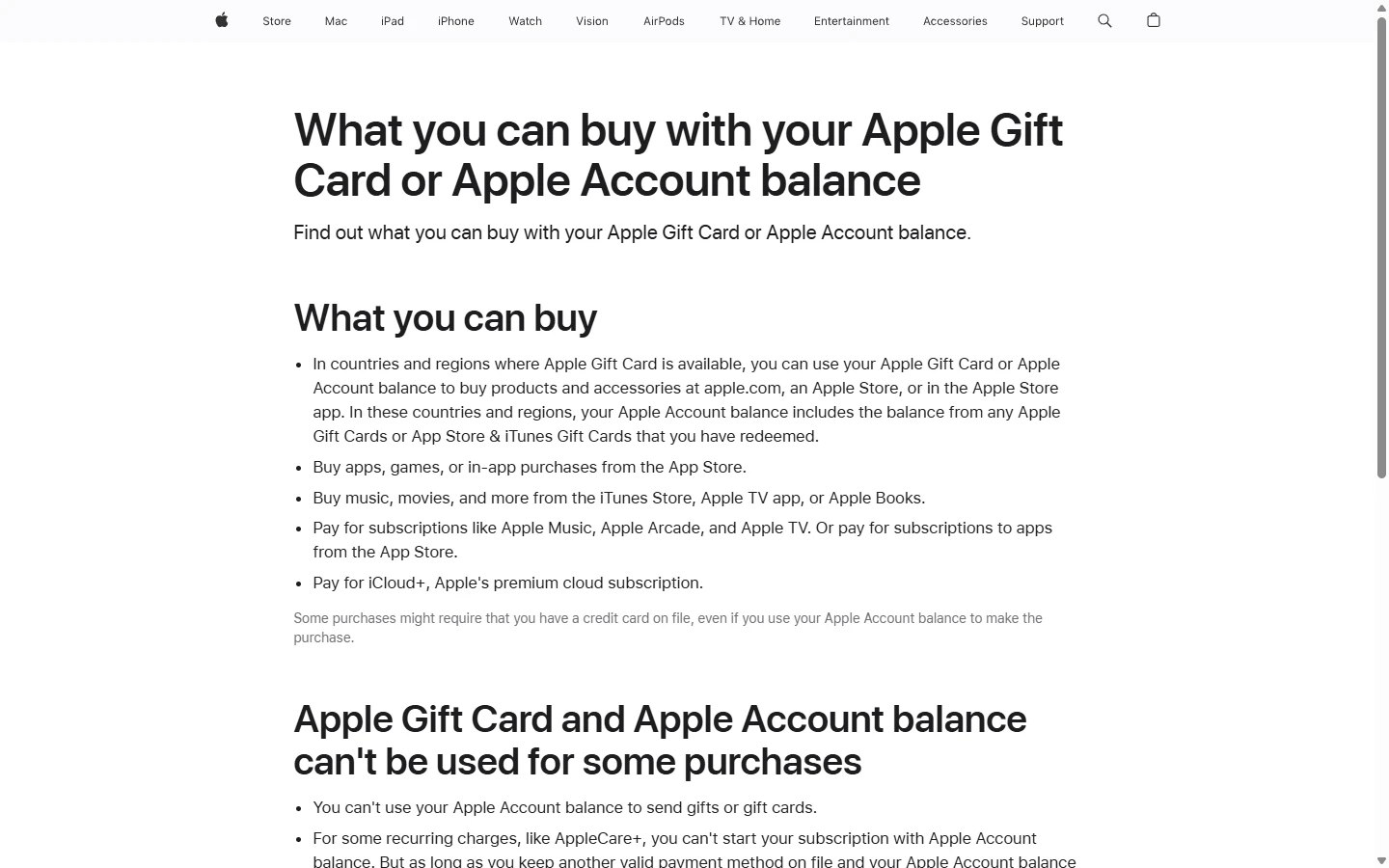
- Apple Support: what you can buy with an Apple Gift Card or balance
- Google Play Help: Accepted payment methods
- Apple Support: how to redeem an Apple Gift Card
All three pages are Apple's and Google's own. What a gift card covers, how its code is redeemed and which payment methods are available still differ from one store region to the next.