No card that works abroad? How to still subscribe to ChatGPT and ClaudeWhy AI subscriptions get declined, and the routes that actually work

An AI subscription gets blocked far more often than ordinary overseas shopping, because it stacks three hard things on top of each other: strict payment risk control, region restrictions, and an automatic monthly charge. Which is why the first wall is simply owning a card that can pay online across borders. The reader I have in mind wants a ChatGPT Plus or Claude Pro subscription, holds only a local card, and can't tell whether to get a proper foreign card or a virtual one. Below I lay out the routes that work, show where each one trips people up, and finish with how to spend a small amount up front to prove whether the card can actually keep renewing.
What's in this guide (open the outline)
- Why AI subscriptions are so picky about a card
- The three routes that can get a subscription paid
- The first charge: what a small test charge is checking
- The real catch is renewal, not the first charge
- How a region mismatch gets detected
- Moved country, or billed in the wrong currency?
- Spend a little to find out whether it will keep renewing
- These situations mean stop
- A few questions people ask
Why AI subscriptions are so picky about a card
Buying a small item overseas is one swipe and done. An AI subscription is different: it's a relationship that lasts for months. For a one-off purchase, risk control only judges "does this single moment look like fraud". For a subscription it also has to judge "will this card pay every month from now on, and is the cardholder really in this region". Those two extra questions are exactly where the declines come from. Pull it apart and three things are colliding:
- Payment processors are strict by design. Most AI tools collect payment through processors like Stripe or Paddle, and their anti-fraud models are naturally wary of the combination "new account plus first time on an unfamiliar card plus cross-border". Blocking first and verifying after is the norm.
- Region limits are a hard rule. Some AI products simply don't open subscriptions in certain regions, or only accept cards issued in certain countries. When that's the case a good card doesn't help; the product side just won't sell to your region.
- Recurring billing magnifies the risk. A subscription authorises the other side to "charge automatically every month". Once it's linked, the system is on the hook for every future charge succeeding, so it judges the card by a higher standard.
Keep those three in mind and it clicks: an AI subscription getting declined often has nothing to do with whether there's money on the card. Some rule decided your card isn't a "stable enough subscription card".
The three routes that can get a subscription paid
Setting aside the uncontrollable "ask a friend to subscribe for you", there are mainly three routes you can run yourself. They differ in difficulty and in who they suit, so place yourself first:
- A genuine foreign-currency credit or debit card. If your bank can issue you a card that supports cross-border online transactions, that's the most direct route: the payment experience comes closest to a local's, and renewals are the most stable. The catch is that many local cards carry a Visa or Mastercard logo yet have cross-border online use switched off by default, or block "subscription merchants" by default; you have to confirm and enable it with the issuer yourself.
- A virtual prepaid card. People who can't get a foreign card most often take this one. You link the subscription to a separate card number, with a controllable balance kept apart from your main account. The catch is that some subscriptions specifically block prepaid and virtual cards, and a renewal fails outright if the balance runs short. How to pick one is in A cheaper virtual card isn't the better one. Check these first.
- A virtual card funded with crypto (USDT). When even a virtual card is hard to top up directly, some virtual cards let you load funds with stablecoin and then pay the subscription. It can route around some local bank limits, but the friction and the risk are higher: where it's legal where you live, you buy USDT on an exchange first, and you carry the exchange-rate movement. The details are in Before you fund a virtual card with USDT, think these through first.
Buying stablecoins such as USDT and using them to move money across borders is regulated very differently from one country to the next, and some places restrict or ban it outright. This guide is written for readers where doing so is permitted. Check the rules where you live and follow local law before you act.
"The card can pay" and "the subscription keeps getting charged" are two different things. A first charge that goes through only proves the card can pay once. The failure people run into comes a month later, when the renewal bounces and the account drops back down, so most of this guide is about confirming the card can keep renewing.
The first charge: what a small test charge is checking
Before you formally subscribe, many AI products run a tiny test charge on the card (refunded soon after, or just a "pre-authorization" hold). It isn't collecting money. It's asking the issuer: is this card real? Can it go cross-border online? Will it stand behind the automatic charges to come?
Understanding it matters, because the way it fails is usually the way your real subscription will fail. There are three common outcomes: the issuer blocks it (the bank app pops "overseas transaction blocked", and confirming it's you usually clears it); it gets stuck at the 3DS second check (no code arrived, no app linked, or it timed out); or it returns "card not accepted" outright (more likely the card type or region being stopped by a product-side rule). The decode card below takes apart the message from this step that people most often misread.
On the subscription checkout"We were unable to authenticate your payment method."
The real catch is renewal, not the first charge
The first charge is the rehearsal; renewal is opening night, and opening night is where it goes wrong most. The usual story: month one subscribes fine, you're enjoying it, then month two brings a "payment failed" and the account drops back to the free tier. The trouble usually sits in one of these:
- The virtual card doesn't have enough for the next cycle. A prepaid or virtual card spends only what's loaded, unlike a credit card with a limit. Load just enough for one month and the next cycle fails on insufficient balance.
- The card's expiry or number changed. Some virtual cards are single-use or short-lived; once they expire the number is void, so naturally the subscription can't charge it.
- The issuer tightens risk control again. The first charge was let through, but the system keeps watching the cross-border behaviour, and at some later cycle it suddenly reads the automatic charge as suspicious and blocks it.
- The region details no longer line up. When the signup region, the card's registered region and the checkout network exit don't agree, a re-check can stop you.
The nastiest thing about a renewal failure is that nobody is watching it the way they watch the first charge. A first-charge failure is obvious on the spot; a renewal failure is often discovered after the fact, once the account has already been downgraded. Better to prove "can it renew steadily" before you subscribe.
How a region mismatch gets detected
"Region mismatch" is the most baffling one, because it doesn't always throw an error; sometimes it just quietly blocks the transaction. First, the signals the product side uses to judge your "region":
- The card's issuing country. Every card carries its issuing country, and the product can read it directly. A local card's issuing country may not be on its list of supported subscription regions.
- The billing address. The country and address you enter at checkout get compared against the card's records and the product's supported regions.
- Your network exit at checkout. Some products also look at the network location you're connecting from. When all three come from three different places, you're more likely to be judged "region suspicious".
An easy thing to get wrong: trying to "fake" a supported region by constantly switching network location usually backfires. The less consistent those three are, the more suspicious you look; coming from the same place is actually steadier. If the region limit is a hard rule, switching payment method beats switching networks.
Moved country, or billed in the wrong currency?
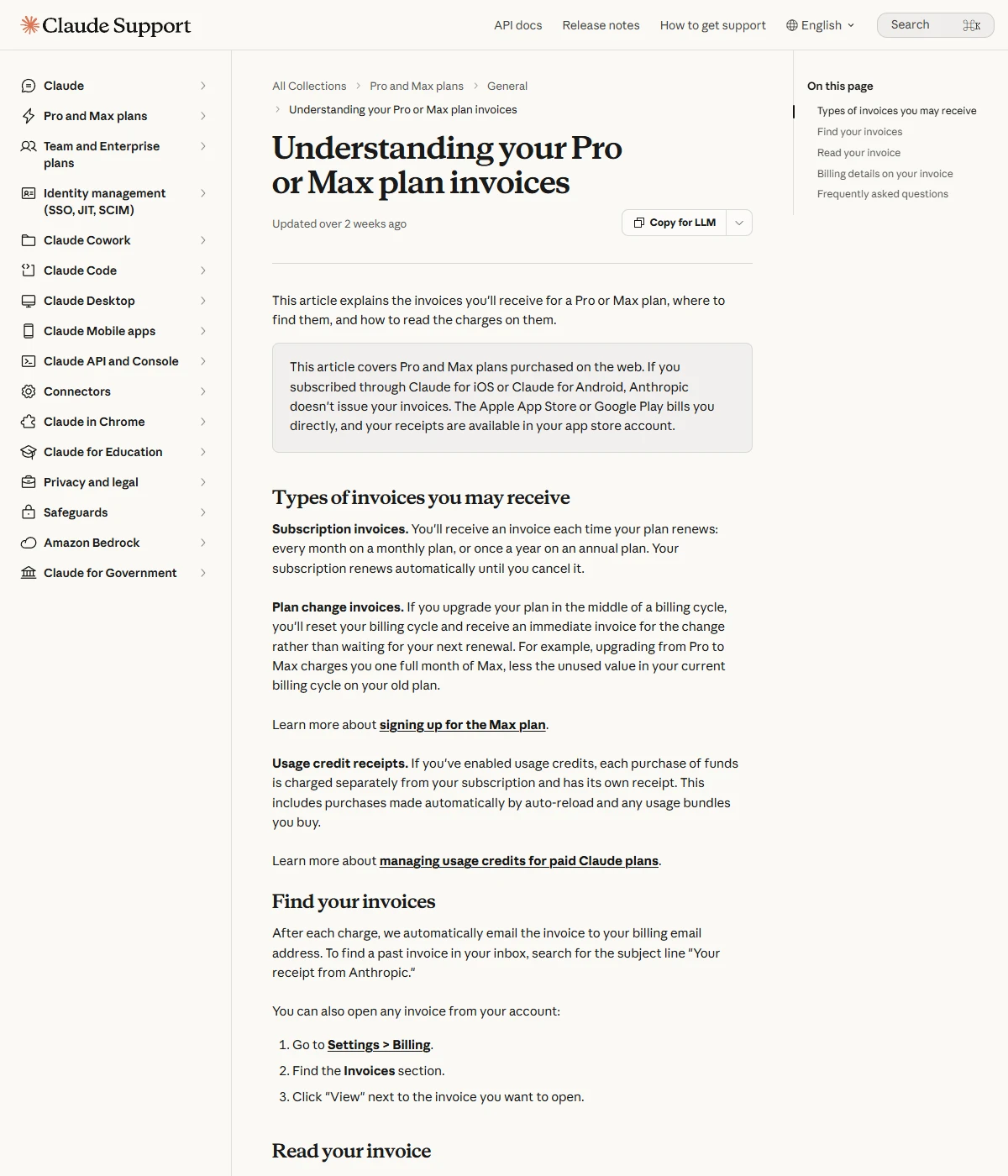
You usually can't switch the currency of a subscription that is already running; the change happens at the next purchase. Claude's help centre spells this out for Pro and Max plans: to change your subscription currency, mark the plan to cancel at the end of the current term, wait for the term to end, then buy a new plan, which uses the same currency options new subscribers in your region are offered. One exception comes first: if you subscribed inside the Claude app on iOS or Android, Anthropic doesn't issue the invoice at all, because Apple or Google bills you directly.
The same page explains the other half. Tax is calculated from your billing address, and that address is taken from your payment method. So the card you pay with decides more than whether the charge goes through: it decides which place's tax the invoice carries, and in practice which prices you see. Edits to your name, address or VAT ID only apply to future invoices; an invoice that has already been issued stays as it is.
ChatGPT's billing rules live in OpenAI's own help centre, which has separate pages on billing details and on multi-currency pricing. Read those in your account before assuming a switch works the same way there. Either way, this order doesn't leave you without access:
- Before the renewal date, add a payment method from the country you're in now: a card issued there, with the address on file there.
- Let the current term run out rather than cancelling mid-way; you've already paid for it.
- Subscribe again once it has ended, and read the currency and tax lines on the checkout before you confirm.
- Leave the second account and the VPN alone. Forcing a region with either makes the card country, billing address and network exit disagree, which is the pattern the previous section describes.
Spend a little to find out whether it will keep renewing
Rather than buy a whole year up front and then wrangle a refund when something breaks, spend ten minutes on a "renewal rehearsal" to confirm the card can not only pay the first charge but survive the second cycle.
- Start with the shortest, cancel-anytime cycle. If monthly is offered, don't jump straight to annual. The first charge is itself the most honest small test of this card, but a successful first charge only means "the first charge cleared", not that it can renew.
- On the virtual-card route, deliberately load enough for two cycles. Don't load just one month; keep the balance clearly above one cycle's fee, so the renewal date won't fail on insufficient balance. The fee follows what the product's page shows at the time.
- Wait for the real second-cycle charge before deciding whether to switch to annual. This is the core: only after you've actually seen the second month auto-renew successfully do you know this is a "card that can renew".
Before you tap "Subscribe", tick down this list. If anything's missing, hold off:
- This card can transact cross-border online, and isn't blocked by default for subscription merchants (confirmed with the issuer).
- This AI product opens subscriptions in my region (checked on the official page).
- If using a virtual card: the balance is above two cycles' fee, not just enough for one month.
- If using a virtual card: the card's expiry is far enough out that it won't lapse before the next charge.
- Signup region, card issuing country and checkout network exit point to the same place as much as possible.
- Pick the shortest cancel-anytime cycle first, and leave annual until after the second charge succeeds.
Once you've run this, you'll know whether the card "can only pay once" or "can renew steadily". If the second cycle charges fine, you can use it long term and even switch to a cheaper cycle. If the second cycle fails, don't keep retrying (several failures in a short window trip risk control); go back to the renewal catches and place it: balance, expiry, risk control or region, then fix the right one and renew.
These situations mean stop
To get one AI tool subscribed, some shortcuts must not be touched. When you see these signals, stop right away:
One: someone offers to "subscribe for you, just hand over the account password, or the card number, expiry and CVV". This is the line you don't cross. Handing over an AI account password gives away every chat and the linked payment details at once; handing over full card details gives away the card. A legitimate subscription never needs a third party to hold your account password or full card number. If you see it, stop.
Two: a "super-cheap shared membership" asks you to pay a "deposit or unlock fee" first before you're let in. Collect money first, deliver later is the classic opening of this kind of scam; legitimate payment has no "pay first before you can start".
Three: the same card keeps failing and you keep swiping it. Risk control reads several failures in a short window as a fraud signal and can lock the card temporarily, which is more hassle. Stop after two or three failures and go find the reason.
A few questions people ask
- No foreign card, so is asking someone to subscribe for me the only option?
- No, and that route carries a lot of risk (you'd have to hand over an account password or card details). The steadier move is to open your own cross-border-capable virtual prepaid card and link the subscription to it. This site doesn't recommend the subscribe-for-you route.
- Does the small test charge get refunded?
- Mostly it's either refunded soon or just a "pre-authorization" hold that releases on its own in a few days, so it isn't a real charge to begin with. If it lingers, check with the issuer. The exact behaviour follows the product's and issuer's notes.
- I subscribed fine with a virtual card, so why did the second month get downgraded?
- The most common cause is insufficient balance on the card at renewal, or the card having expired. After that comes the issuer tightening risk control again, or the region details not lining up. Check balance and expiry first, then look at risk control and region.
- Can I get around a region limit by switching network location?
- If it's the product's hard region rule, switching networks usually does nothing and instead leaves the card's issuing country, billing address and network exit even less consistent, which looks more suspicious. Keeping those three as aligned as possible is steadier than flipping back and forth.
Sources to check: whether your region is supported, and the current price and billing rules, follow each AI product's official subscription or help page; whether a card can go cross-border online and be used for subscription merchants, follow your issuer's app or support. This guide only explains the mechanics and how to narrow it down, and gives no specific fees or promises. Updated 2026-09-12.
References
- OpenAI Help Center: Billing & payment
- Claude Help Center: understanding your Pro or Max plan invoices
- OpenAI Help Center: multi-currency billing
The OpenAI pages are OpenAI's own billing notes, and the Claude page is Anthropic's. Each product writes its own rules and revises them, so check the one you're paying for before you subscribe or switch.